MicrobeGrower
Beyond the Soil Test: Understanding the Living System Beneath Your Feet
Science-backed insights on soil biology, regenerative agriculture, and building living soil systems that reduce inputs while increasing yields.

More Than Mud: The Secret Life of Your Soil and How to Feed It
The soil ecosystem operates through specialized microbial guilds, each performing distinct ecological functions:

Unlocking Clay Soils: The Science of Flocculation and Calcium Management
When clay platelets lie flat against one another in tightly packed arrangements—a condition called dispersion—the microscopic pore spaces essential for air and water movement effectively disappear. Oxygen cannot penetrate to support root respiration or aerobic microbial activity.
Powdery Mildew Defense: Building a Living Fungal Shield Through Foliar Biology
Conventional fungicide programs require continuous investment with no reduction over time as resistance develops. Biological approaches involve lower long-term direct costs. Once beneficial populations establish, application frequency typically decreases while effectiveness increases, creating improving economics over successive seasons.

Natural Aphid Control: Building Your Garden's Defense Team
The sustainable solution lies not in sprays and chemicals, but in cultivating the natural predators that have controlled aphid populations for millions of years. By understanding and supporting these beneficial organisms, you can establish a self-regulating system that maintains aphids at manageable levels without constant intervention.
- Dec 29, 2025
More Than Mud: The Secret Life of Your Soil and How to Feed It
Understanding the Soil Food Web: A Scientific Approach to Regenerative Garden Management
When examining a sample of garden soil, the trained observer recognizes a complex ecological system rather than mere particulate matter. What may appear as uniform substrate to the casual eye represents a dynamic biological community—a micro-scale ecosystem whose functional diversity directly correlates with plant health, nutrient cycling efficiency, and overall garden productivity.
Distinguishing Inert Substrate from Living Soil
The fundamental distinction between sterile substrate and functional soil lies in biological activity. Inert material—depleted topsoil or mineral sediment—lacks the microbial consortia necessary for nutrient transformation and disease suppression. In contrast, biologically active soil harbors extraordinary organismal density: research indicates that a single gram of healthy soil contains approximately 10⁹ bacterial cells and several meters of fungal hyphae, exceeding global human population numbers within a teaspoon-sized sample.
This "living soil" paradigm represents the foundation of sustainable horticulture. The presence and activity of soil biota directly influence plant resilience, nutritional density, and natural pest resistance through mechanisms that synthetic inputs cannot replicate.
Key Functional Groups in the Soil Food Web
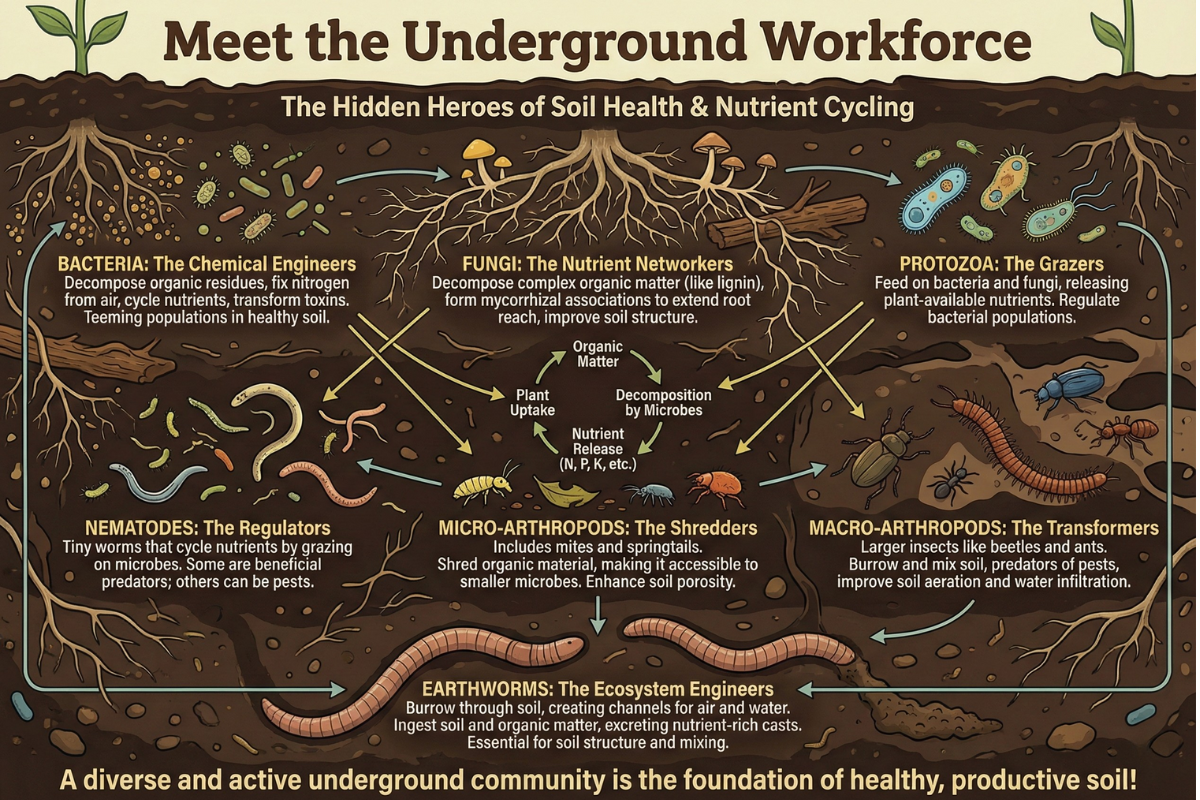
The soil ecosystem operates through specialized microbial guilds, each performing distinct ecological functions:
Bacteria constitute the primary decomposers of simple organic compounds. These prokaryotic organisms rapidly metabolize readily available carbon sources, simultaneously producing exopolysaccharides—biopolymers that aggregate soil particles into stable microstructures, thereby improving water retention and aeration.
Fungi serve as the soil's primary architects of nutrient transport networks. Mycorrhizal associations and saprophytic fungal networks extend meters beyond root zones, dramatically expanding the effective absorption area for water and mineral nutrients while providing structural stability through hyphal binding.
Protozoa and nematodes function as higher-level consumers within the microbial food chain. Their predation on bacterial and fungal biomass drives nutrient mineralization—the conversion of organically-bound nutrients into plant-available forms. This process, known as the "microbial loop," releases nitrogen, phosphorus, and other essential elements in synchrony with plant demand.
The Rhizosphere: A Plant-Mediated Microbial Habitat
Plants function as active ecosystem engineers rather than passive nutrient recipients. Through photosynthate allocation, plants exude 20-40% of fixed carbon into the rhizosphere as low-molecular-weight organic compounds. This strategic investment—termed rhizodeposition—selectively cultivates microbial communities that provide specific services: nutrient solubilization, pathogen suppression, or stress tolerance enhancement.
This reciprocal exchange represents a co-evolutionary partnership refined over hundreds of millions of years, demonstrating that sustainable agriculture must work with, rather than against, these natural processes.
Direct Observation: Microscopy as a Diagnostic Tool
Quantitative assessment of soil biological activity eliminates guesswork from garden management. Standard brightfield microscopy (400-1000× magnification) enables direct enumeration of bacterial cells, fungal hyphal diameter, protozoan activity, and nematode functional groups. Observing ciliate protozoa actively grazing bacterial colonies provides real-time confirmation of nitrogen mineralization—the very process that drives nutrient availability in natural systems.
This evidence-based approach allows practitioners to make informed management decisions based on observable biological parameters rather than empirical assumptions.
Evidence-Based Practices for Soil Food Web Enhancement
Regenerating soil biological function requires practices that support microbial proliferation while avoiding disruption of established communities. Research consistently demonstrates that synthetic nitrogen fertilizers suppress microbial diversity and disrupt natural nutrient cycling, creating dependency while degrading long-term soil function.
Thermophilic composting produces stabilized organic matter with documented benefits: pathogen and weed seed mortality through sustained temperatures of 55-65°C, while simultaneously increasing microbial biomass density four to eight-fold relative to source materials. Properly managed compost provides both microbial inoculant and substrate for continued biological activity.
Compost extracts and teas deliver concentrated microbial consortia directly to plant root zones and leaf surfaces. These liquid applications establish beneficial organisms on plant tissues, outcompeting potential pathogens while supporting nutrient transformation in the immediate rhizosphere.
Surface mulching maintains soil moisture, moderates temperature extremes, and provides continuous substrate input for decomposer communities. This practice mimics natural litter accumulation, creating favorable microhabitat conditions for sustained biological activity.
The principle underlying these methods is straightforward: supporting soil biological communities creates a self-regulating system wherein nutrient availability, disease suppression, and soil structure improvement occur through natural processes. This represents genuine sustainability—reducing external inputs while simultaneously improving system function.
Take Action: Build Your Living Soil System
Ready to transform your garden through soil biology? Begin with these three essential resources:
Complete Soil Food Web Inoculum – A professionally-produced, full-spectrum microbial concentrate containing bacteria, fungi, protozoa, and beneficial nematodes in balanced proportions. Apply to establish diverse biological communities in new gardens or rehabilitate depleted soils.
Premium Compost & Soil Amendment – Thermophilically-processed organic matter serving as both microbial habitat and slow-release nutrient source. Use as a biological "seed bank" to introduce and sustain diverse soil organisms while improving physical soil properties.
Soil Microscopy Fundamentals Course – A comprehensive training program teaching proper sample preparation, organism identification, and quantitative assessment techniques. Learn to evaluate your soil's biological status, track improvement over time, and make data-driven management decisions.
Invest in understanding what you cannot see, and you'll transform everything you can observe in your garden.