MicrobeGrower
Beyond the Soil Test: Understanding the Living System Beneath Your Feet
Science-backed insights on soil biology, regenerative agriculture, and building living soil systems that reduce inputs while increasing yields.

More Than Mud: The Secret Life of Your Soil and How to Feed It
The soil ecosystem operates through specialized microbial guilds, each performing distinct ecological functions:

Unlocking Clay Soils: The Science of Flocculation and Calcium Management
When clay platelets lie flat against one another in tightly packed arrangements—a condition called dispersion—the microscopic pore spaces essential for air and water movement effectively disappear. Oxygen cannot penetrate to support root respiration or aerobic microbial activity.
Powdery Mildew Defense: Building a Living Fungal Shield Through Foliar Biology
Conventional fungicide programs require continuous investment with no reduction over time as resistance develops. Biological approaches involve lower long-term direct costs. Once beneficial populations establish, application frequency typically decreases while effectiveness increases, creating improving economics over successive seasons.

Natural Aphid Control: Building Your Garden's Defense Team
The sustainable solution lies not in sprays and chemicals, but in cultivating the natural predators that have controlled aphid populations for millions of years. By understanding and supporting these beneficial organisms, you can establish a self-regulating system that maintains aphids at manageable levels without constant intervention.

- Dec 30, 2025
Unlocking Clay Soils: The Science of Flocculation and Calcium Management
Clay soils present a paradox for agricultural producers and gardeners alike. When properly managed, these soils offer exceptional nutrient retention, water-holding capacity, and long-term fertility that can sustain productive systems for generations. Yet when mismanaged, these same soils become nearly impenetrable barriers—waterlogged during wet periods, concrete-hard when dry, and hostile to root development and soil biological activity throughout the growing season.
The difference between these two states often comes down to a single soil characteristic that receives insufficient attention in conventional management: flocculation. Understanding and managing the flocculation status of clay soils represents one of the most powerful—and most overlooked—strategies for improving soil function, reducing production costs, and increasing agricultural resilience.
The Clay Soil Challenge: Structure Determines Function
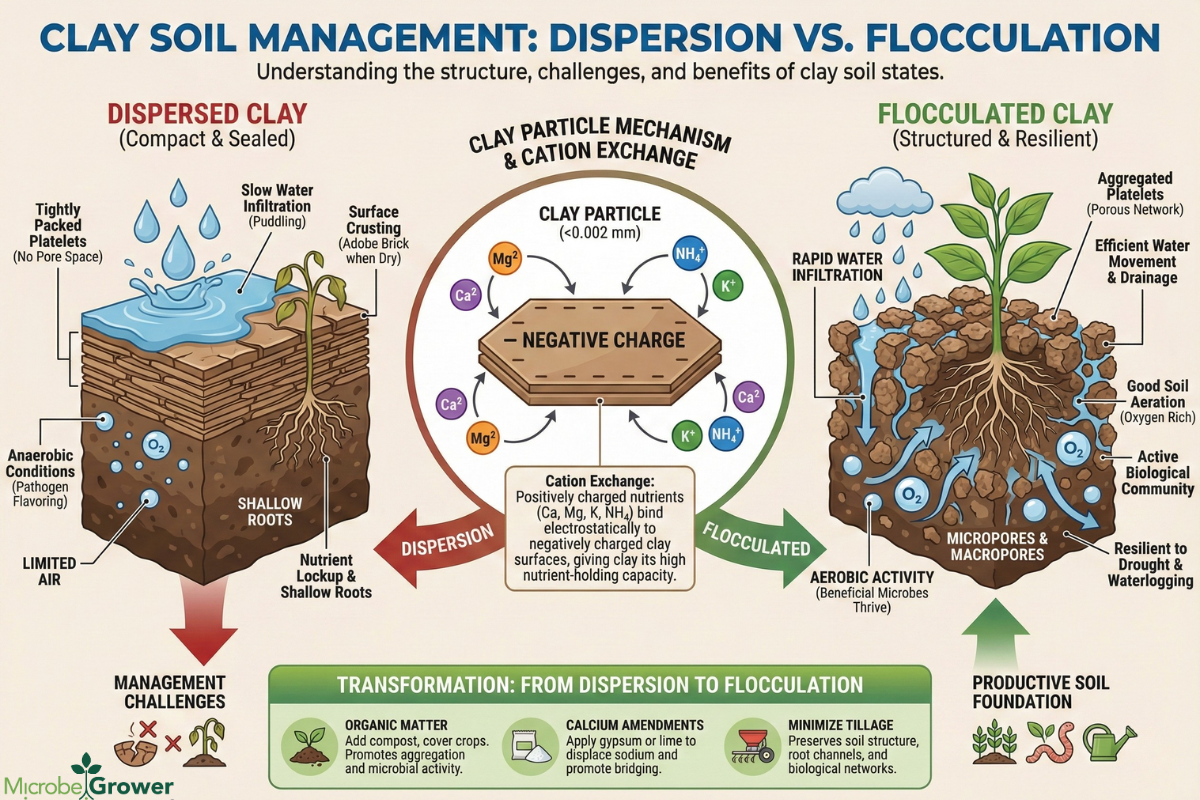
Clay particles are extraordinarily small—less than 0.002 millimeters in diameter—with plate-like structures and negatively charged surfaces. These characteristics give clay soils their remarkable nutrient-holding capacity, as positively charged nutrients (calcium, magnesium, potassium, ammonium) bind electrostatically to clay surfaces in a process called cation exchange. This same chemistry, however, creates management challenges that distinguish clay soils from sandier textures.
When clay platelets lie flat against one another in tightly packed arrangements—a condition called dispersion—the microscopic pore spaces essential for air and water movement effectively disappear. Oxygen cannot penetrate to support root respiration or aerobic microbial activity. Water infiltration slows to rates measured in fractions of an inch per hour. Roots encounter physical resistance that limits exploration and nutrient access. The soil becomes functionally anaerobic despite surface exposure to atmosphere, creating conditions that favor pathogenic organisms while suppressing beneficial microbes.
This dispersed state manifests in familiar symptoms: surface crusting after rainfall, water puddling rather than infiltrating, cloddy texture when worked, and the characteristic "adobe brick" consistency when dry. Crops growing in dispersed clay soils exhibit shallow root systems, nutrient deficiencies despite adequate soil test levels, and heightened susceptibility to both drought stress and waterlogging—often within the same growing season.
The alternative condition—flocculation—transforms these same clay particles into the foundation of highly productive soil. When clay platelets are spaced apart rather than compressed together, the resulting structure creates networks of micropores and macropores that facilitate air exchange, water movement, and biological activity. Flocculated clay soils absorb rainfall rapidly, drain excess water efficiently, yet retain plant-available moisture during dry periods. Roots penetrate deeply and explore thoroughly. Aerobic microorganisms thrive, driving nutrient cycling and disease suppression. The soil becomes resilient, responsive, and remarkably forgiving of variable weather conditions.
The critical question becomes: what controls whether clay exists in a dispersed or flocculated state?
The Calcium-Magnesium Relationship: Chemistry of Clay Spacing
Clay flocculation depends fundamentally on the cations occupying exchange sites on clay particle surfaces. Not all cations influence clay behavior equally. Sodium causes extreme dispersion—even small amounts of exchangeable sodium create nearly impermeable soil conditions, as evidenced by saline-sodic soils in arid regions. Potassium and ammonium provide minimal flocculating effect. Magnesium occupies an intermediate position, providing some structural benefit but limited flocculation capacity.
Calcium, however, functions as the primary flocculating cation. When calcium saturates a substantial proportion of exchange sites, clay platelets develop sufficient electrostatic repulsion to space apart from one another. This repulsion—counterintuitive as it may seem—creates the separation necessary for air and water movement. The mechanism involves the hydration shell surrounding calcium ions: as calcium-saturated clay platelets approach one another, their overlapping hydration shells generate repulsive forces that maintain spacing even under the compressive forces of rainfall impact, equipment traffic, or natural settling.
The optimal calcium-to-magnesium ratio for flocculation varies by clay mineralogy, reflecting differences in crystal structure, surface charge density, and swelling characteristics among clay types. This variation has profound practical implications for soil management.
Montmorillonite clays—also called smectites—represent the most reactive and challenging clay type. These clays exhibit exceptional cation exchange capacity (80-120 meq/100g) and significant swelling behavior when wetted. Their high charge density and expansive character require calcium dominance to maintain flocculation. Research and field experience indicate that montmorillonite clays require calcium-to-magnesium ratios approaching 7:1 or higher to sustain adequate flocculation under field conditions. At lower ratios, these clays tend toward dispersion, particularly during wet periods when swelling forces are most pronounced.
Illite clays demonstrate intermediate characteristics with moderate cation exchange capacity (15-40 meq/100g) and limited swelling. Their lower charge density and more stable structure permit adequate flocculation at calcium-to-magnesium ratios of approximately 3:1 to 5:1. These soils typically prove less problematic to manage than montmorillonite clays but still benefit substantially from maintaining calcium dominance.
Kaolinite clays exhibit low cation exchange capacity (3-15 meq/100g) and minimal swelling characteristics. Their relatively simple crystal structure and low surface charge density allow satisfactory flocculation at calcium-to-magnesium ratios as low as 2:1 to 3:1. These clays, common in highly weathered soils of tropical and subtropical regions, present fewer structural management challenges related to flocculation, though they may require attention to other fertility considerations.
Understanding your soil's dominant clay mineralogy provides the foundation for targeted calcium management. Standard soil testing laboratories can identify clay types through X-ray diffraction analysis, though careful observation of soil behavior often provides adequate inference for management purposes.
Practical Calcium Management: From Theory to Implementation
Establishing and maintaining appropriate calcium saturation requires strategic amendment selection and application. The objective is not simply to increase total calcium in soil—which can be accomplished with numerous materials—but rather to increase exchangeable calcium relative to other cations, particularly magnesium and sodium.
Gypsum (calcium sulfate) provides the most versatile calcium amendment for flocculation management. Its moderate solubility supplies calcium gradually without drastically altering soil pH, making it suitable for soils across the pH spectrum. The sulfate component offers additional benefits: sulfur nutrition for plants, and a mild acidifying effect that can improve calcium availability in neutral to alkaline soils. Gypsum proves particularly valuable for sodic soil reclamation and magnesium displacement in soils with excessive magnesium saturation.
Application rates depend on current cation ratios and clay content. Soils with severe dispersion may require 1-3 tons per acre initially, followed by maintenance applications of 500-1000 pounds annually. The key is consistency—flocculation management represents an ongoing soil health practice rather than a one-time correction.
Calcium carbonate (agricultural lime) serves dual purposes: increasing pH in acidic soils while supplying calcium. In regions with naturally acidic soils and high rainfall, lime represents the primary calcium source for most agricultural systems. Material selection matters—high-calcium limestone provides pure calcium carbonate, while dolomitic limestone contains significant magnesium and should be avoided when correcting calcium-to-magnesium imbalances.
Calcium hydroxide (hydrated lime) offers rapid pH adjustment and calcium delivery but requires careful application due to its caustic nature. This material suits situations requiring quick correction of severe acidity combined with calcium deficiency.
Calcium chloride provides highly soluble calcium for rapid correction of severe flocculation problems, though the chloride component limits application rates and frequency. This material typically serves specialized situations rather than routine management.
Organic amendments contribute indirectly to flocculation through multiple mechanisms. Compost supplies calcium in moderate amounts while simultaneously improving soil aggregation through biological activity and organic matter accumulation. The humic substances in well-decomposed organic matter help stabilize soil structure and enhance cation exchange capacity. Critically, active soil biology supported by organic amendments helps maintain flocculation through the production of bacterial exopolysaccharides and fungal hyphae—biological "glues" that reinforce particle spacing created by calcium.
Beyond Calcium: Integrated Flocculation Management
While calcium management forms the chemical foundation of clay flocculation, optimal soil structure requires integration with biological and physical management practices.
Biological activity proves essential for sustained structural stability. Bacterial and fungal populations produce extracellular polymers that cement soil particles into stable aggregates. These aggregates protect individual clay particles from re-dispersion while creating the macropore networks necessary for air and water movement. Management practices that support biological activity—reduced tillage, continuous living cover, diverse crop rotations, and compost addition—work synergistically with calcium to create stable, flocculated soil structure.
Minimizing compaction preserves flocculated structure once established. Traffic on wet clay soils causes mechanical compression that overwhelms the electrostatic forces maintaining particle spacing. Restricting field operations to appropriate moisture conditions, using controlled traffic patterns, and reducing axle loads all help maintain the structural benefits of flocculation.
Strategic tillage timing can enhance or destroy flocculation effects. Working clay soils at excessive moisture content causes smearing and compaction that promotes dispersion. Tillage when soils are too dry creates clods that resist re-aggregation. The optimal moisture range—often described as "friable" condition where soil crumbles readily—allows tillage to facilitate rather than harm soil structure.
Avoiding sodium accumulation prevents dispersion regardless of calcium levels. Irrigation water quality, manure characteristics, and fertilizer selection all influence sodium loading. In regions with sodium-bearing water sources or naturally high soil sodium, active management through gypsum application and drainage becomes essential.

Monitoring and Adaptive Management
Successful flocculation management requires periodic assessment and responsive adjustment. Several practical indicators help evaluate current status and guide management decisions.
Soil testing provides quantitative data on exchangeable cations and calculated ratios. Standard soil test reports typically include calcium, magnesium, potassium, and sodium levels. Requesting cation saturation percentages allows direct calculation of calcium-to-magnesium ratios for comparison with targets appropriate to your clay type.
Infiltration testing offers immediate functional assessment. Simple infiltration rings or even informal observation of how quickly water penetrates soil after rainfall reveals changes in flocculation status. Well-flocculated clay soils should absorb rainfall at rates of 0.5 to 2+ inches per hour, depending on organic matter content and biological activity levels.
Structural observation provides qualitative assessment accessible to any producer. Well-flocculated soil exhibits granular or blocky structure with visible aggregation rather than massive, structureless appearance. When moistened and worked between fingers, flocculated clay forms soft ribbons that break readily, while dispersed clay creates long, plastic ribbons.
Crop performance patterns often reveal flocculation problems before formal testing. Shallow rooting, stunted growth following wet periods, and variable stand establishment across fields suggest structural limitations worth investigating.
The Economic Logic of Flocculation Management
Investment in calcium management and flocculation delivers returns through multiple pathways. Improved water infiltration reduces runoff losses, erosion, and flooding risk while increasing stored soil moisture for crop use. Enhanced aeration supports deeper rooting, improving drought resilience and nutrient access. Better soil structure reduces fuel costs and equipment wear during field operations. More active soil biology enhances nutrient cycling, potentially reducing fertilizer requirements.
Perhaps most significantly, well-flocculated clay soils provide operational flexibility. Fields that dry adequately for timely planting and harvest operations, that resist compaction under necessary traffic, and that perform consistently across variable weather conditions allow producers to execute optimal management rather than compromise continuously with poor soil conditions.
These benefits accumulate over time. Calcium management represents long-term soil improvement rather than annual input expense—applied calcium remains active for multiple years, while biological and structural improvements compound with sustained proper management.
Transform Your Clay Soils: Expert Consultation Services
1. Comprehensive Clay Soil Analysis & Calcium Management Plan
Schedule a complete assessment of your soil's mineralogy, current cation balance, and flocculation status. This service includes detailed soil testing with clay type identification, infiltration measurements, structural evaluation, and a customized calcium amendment protocol with application rates, timing, and projected improvement timeline. Receive a written report with specific product recommendations and implementation priorities tailored to your operation. [Book Your Clay Soil Assessment]
2. On-Farm Flocculation Workshop & Training
Bring hands-on learning directly to your operation. This half-day intensive covers clay soil identification, field evaluation techniques, amendment selection and application methods, and integration with your existing management practices. Learn to assess flocculation status yourself, make informed amendment decisions, and monitor improvement over time. Includes follow-up consultation to review results after your first growing season. [Schedule Your On-Farm Workshop]
3. Season-Long Soil Structure Optimization Program
Work directly with a soil health specialist throughout your growing season to systematically improve clay soil function. This comprehensive program includes baseline and follow-up testing, quarterly field evaluations, customized amendment recommendations adjusted to crop response, and priority access for troubleshooting. Limited to producers committed to measurable soil improvement. [Apply for Optimization Program]
Don't let problematic clay soils limit your productivity another year. Proper flocculation management transforms your most challenging acres into your most productive and resilient land.