MicrobeGrower
Beyond the Soil Test: Understanding the Living System Beneath Your Feet
Science-backed insights on soil biology, regenerative agriculture, and building living soil systems that reduce inputs while increasing yields.

More Than Mud: The Secret Life of Your Soil and How to Feed It
The soil ecosystem operates through specialized microbial guilds, each performing distinct ecological functions:

Unlocking Clay Soils: The Science of Flocculation and Calcium Management
When clay platelets lie flat against one another in tightly packed arrangements—a condition called dispersion—the microscopic pore spaces essential for air and water movement effectively disappear. Oxygen cannot penetrate to support root respiration or aerobic microbial activity.
Powdery Mildew Defense: Building a Living Fungal Shield Through Foliar Biology
Conventional fungicide programs require continuous investment with no reduction over time as resistance develops. Biological approaches involve lower long-term direct costs. Once beneficial populations establish, application frequency typically decreases while effectiveness increases, creating improving economics over successive seasons.

Natural Aphid Control: Building Your Garden's Defense Team
The sustainable solution lies not in sprays and chemicals, but in cultivating the natural predators that have controlled aphid populations for millions of years. By understanding and supporting these beneficial organisms, you can establish a self-regulating system that maintains aphids at manageable levels without constant intervention.
- Jan 2
5 Plant ‘Truths’ That Are Actually Killing Your Garden
Introduction: The Secrets Beneath Your Feet
Are you tired of battling mysterious pests, constantly watering thirsty plants, and watching your garden fail to thrive despite your best efforts? Many of us have been taught to focus on the leaves, stems, and flowers, believing that the right spray or fertilizer is the key to success. But what if I told you the real secrets to a plant's health are hidden in a world most of us ignore: the complex, living ecosystem of the soil.
Many of our foundational beliefs about how plants grow roots, get nutrients, and defend themselves are incomplete or just plain wrong. They are artifacts of a broken system. The truth is that our plants are constantly sending us messages, and the answers aren't in a bottle—they're in the soil. Prepare to have your perspective shifted as we debunk five common myths and reveal the surprising truths that will fundamentally change how you see your garden.
Your Plant's Roots Aren't Meant to Be Shallow
Myth: Plant roots naturally stay close to the surface.
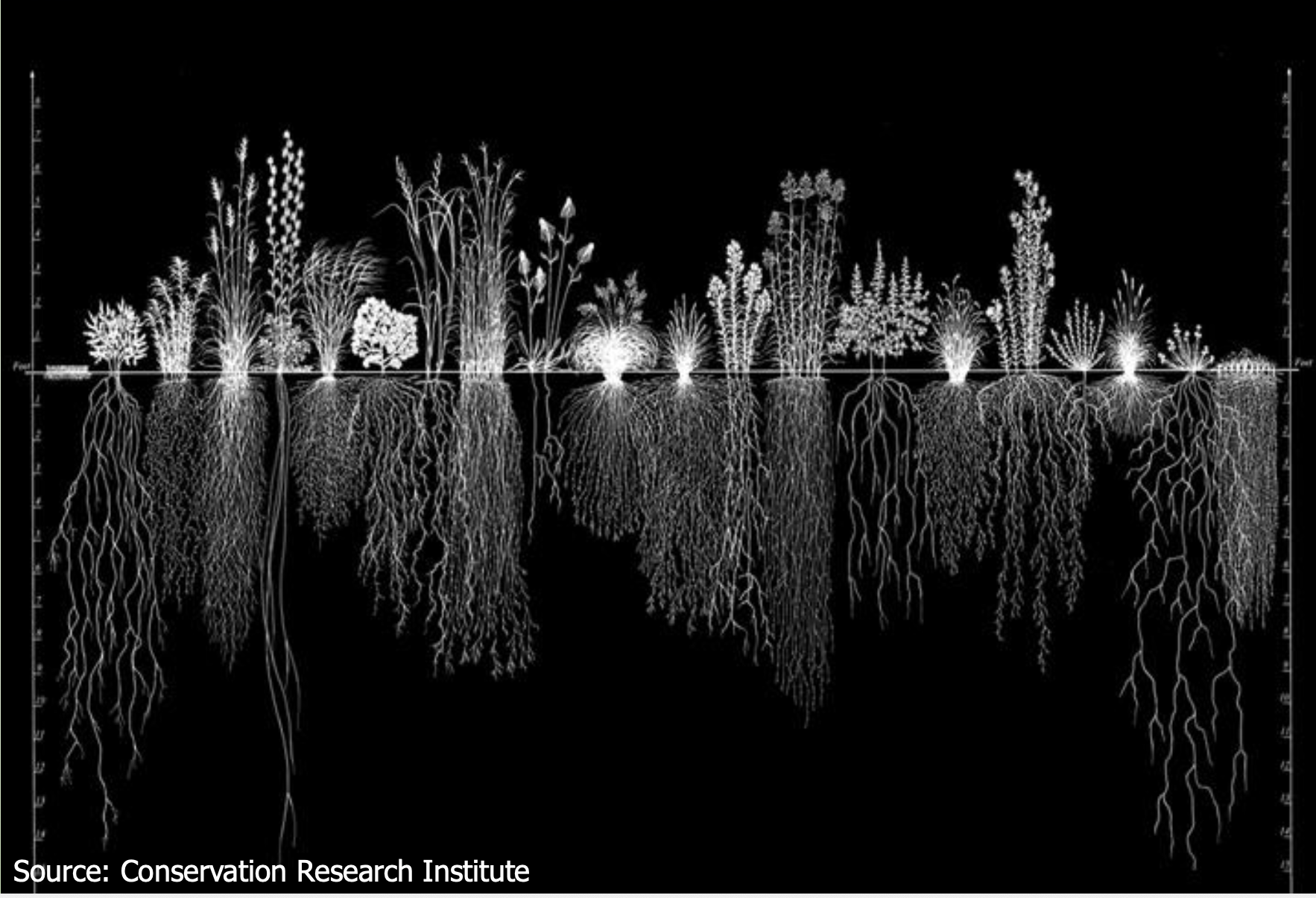
The common sight of shallow roots in our lawns and gardens is not a rule of nature; it is evidence of widespread damage we have inflicted on our soil. We see roots go down a few inches and spread sideways, and we assume it’s normal. It’s not. This is an "artifact of the damage that human beings have done to the soil," specifically by converting living soil into compacted, lifeless dirt.
A powerful experiment makes this distinction shockingly clear. Researchers took a 10cm wide PVC pipe and tried to pound it into a typical patch of compacted turf. After a few hard swings, the pipe was only three inches deep; any more force risked shattering it. But in a nearby plot restored with well-structured, biologically active soil, they easily sank the same pipe a full four feet into the ground. It took heavy equipment to pull that cylinder of soil back up.
When they washed the dirt away, the results were astonishing. In the compacted plot, the grass roots were a few pathetic inches long, and the lawn was plagued by weeds and disease. In the healthy soil, the same grass had grown a massive root system reaching down four and a half feet. That lawn stayed green all summer without watering and had no pest or weed problems.
The most productive prairie grasses send roots down 15 to 25 feet. The message is clear: shallow roots are a sign of broken soil. Deep, healthy roots—the key to drought-resistant, self-sufficient plants—are only possible in a living, well-structured ecosystem.
A Stressed Plant Will Steal From Itself to Survive
Truth: Plants will cannibalize their own leaves to feed their seeds.
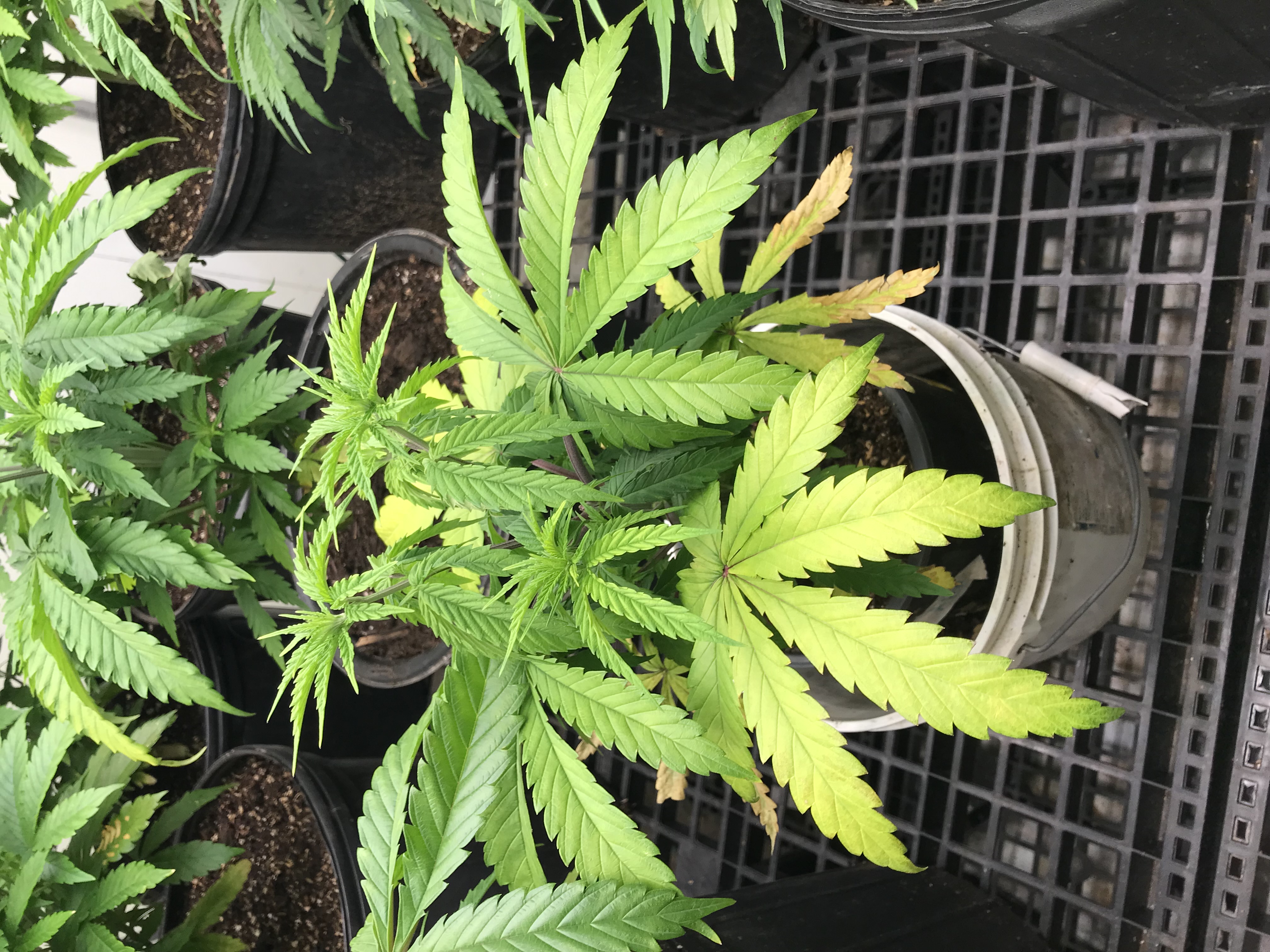
A plant’s primary directive is to reproduce. Creating flowers and seeds is an energy-intensive process that demands a massive amount of nutrients. When a plant can't get what it needs from the soil during this critical phase, it sends out a desperate S.O.S. that you can see with your own eyes.
It will begin to steal essential nutrients like nitrogen and phosphorus from its own body—specifically its lower leaves—and redirect them to the flowers and seeds. If you see the lowest leaves on your plant turning brown, curling up, and dying while it’s trying to fruit or flower, this isn’t a random blemish. It is a direct message.
As the soil expert explains:
If you're seeing that, that's nature trying to send you a message that you don't have enough nutrient cycling in the soil. Your plant is limited in fertility.
This nutrient stress also cripples the plant’s immune system, making it a sitting duck for diseases and pests. That yellowing leaf isn't the problem; it's a plea to fix the fertility of the soil.

Pests and Diseases Are Just Messengers
Insight: Pests aren't the problem; they're the symptom.
When you spot aphids on your roses or powdery mildew on your squash, your first instinct is probably to ask, "How do I kill this?" The real question you should be asking is, "What is my soil lacking?"
In a healthy ecosystem, a vast community of beneficial microorganisms migrates from the soil up the plant's stem in the springtime, covering every leaf. This creates a protective "living armor" that defends against disease-causing spores and deters pests. But if you only have dead dirt, the plant is left naked and undefended.
Consider slugs and snails. They are attracted to alcohol, which is produced by anaerobic organisms that thrive in compacted, waterlogged, unhealthy soil. Their presence is a direct signal that your soil can’t breathe. Treating the pest is a short-term fix for a symptom. The long-term solution is to build a healthy soil ecosystem that can defend its own plants.
Mowing Your Lawn Doesn't Instantly Kill Its Roots
Myth: Cutting your grass makes its roots fall off.
There's a persistent horticultural myth that when you cut the top of a grass plant, its roots immediately die back or "fall off" because the top can no longer support them. This is illogical. As the source material bluntly puts it, "...when you go on a starvation diet for a day or two, your feet don't fall off." Why would a plant discard the very system it needs to regrow?
What actually happens when a healthy plant is cut or grazed is a deliberate, strategic act. It responds by flushing a surge of sugars (exudates) out of its roots. This isn't a sign of weakness; it's an investment. This sugar "pays" the microbial community in the soil to jump-start the nutrient cycle, rapidly unlocking the exact minerals the plant needs to fuel new growth.
The roots don't "fall off." The system collapses from slow starvation when the plant is repeatedly cut too soon, before it has time to photosynthesize and replenish the sugars it invested. That repeated stress—not a single mow—is what eventually kills the root system.
The Textbook Model of How Plants Eat is "Wrong"
Surprise: Plants and microbes create custom pH zones to unlock nutrients.
The textbook model of how plants eat is simple: a root releases acid to free up positively charged nutrients from soil particles. The speaker in the source material calls this model "wrong," and for good reason. It’s a dangerously incomplete story.
It has no explanation for how plants acquire essential, negatively charged nutrients (anions) like nitrate and sulfate. The acid-exchange model only works for positive ions (cations).
It completely fails in alkaline soils, like those in the world's most productive grasslands, where key nutrients would be chemically locked up and unavailable.
-
It foolishly ignores the billions of bacteria and fungi in the soil, which are far more efficient at grabbing nutrients than a plant root ever could be on its own.
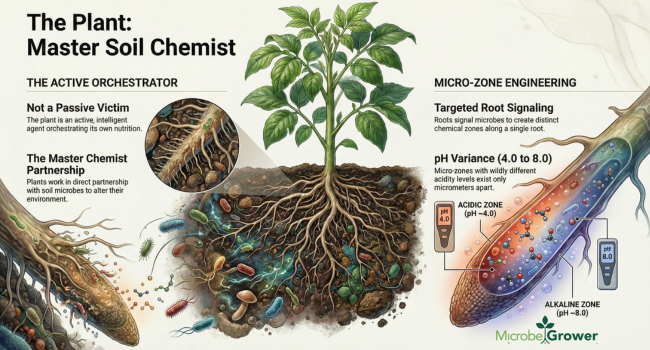
Here is the revolutionary truth: the plant is not a passive victim of its environment. It is an active, intelligent agent orchestrating its own nutrition. In partnership with soil microbes, a plant acts as a master chemist. Along a single root, it can signal microbes to create tiny, distinct zones with wildly different pH levels. One spot might be a pH of 6, while micrometers away another is a pH of 8, and another is a pH of 4.
This is the "wow" moment of modern soil science. By creating these precise micro-environments on demand, the plant and its microbial partners can mine and absorb any specific nutrient it needs, at any time, from the surrounding soil. This renders the entire idea of a single "perfect" soil pH completely obsolete.
Conclusion: Stop Treating Plants, Start Feeding Soil
The theme is undeniable: the key to resilient, healthy plants is not found in sprays, chemical fertilizers, or fighting symptoms. It lies in cultivating a living, well-structured soil ecosystem.
Our plants are constantly communicating with us. A yellow leaf, a wilting stem, or an insect infestation are not failures to be eliminated, but messages to be understood. They are all pointing to the same place: the ground beneath your feet.
The next time you see a pest or a browning leaf, will you reach for a quick fix, or will you stop and ask what your soil is trying to tell you?