MicrobeGrower
Beyond the Soil Test: Understanding the Living System Beneath Your Feet
Science-backed insights on soil biology, regenerative agriculture, and building living soil systems that reduce inputs while increasing yields.

More Than Mud: The Secret Life of Your Soil and How to Feed It
The soil ecosystem operates through specialized microbial guilds, each performing distinct ecological functions:

Unlocking Clay Soils: The Science of Flocculation and Calcium Management
When clay platelets lie flat against one another in tightly packed arrangements—a condition called dispersion—the microscopic pore spaces essential for air and water movement effectively disappear. Oxygen cannot penetrate to support root respiration or aerobic microbial activity.
Powdery Mildew Defense: Building a Living Fungal Shield Through Foliar Biology
Conventional fungicide programs require continuous investment with no reduction over time as resistance develops. Biological approaches involve lower long-term direct costs. Once beneficial populations establish, application frequency typically decreases while effectiveness increases, creating improving economics over successive seasons.

Natural Aphid Control: Building Your Garden's Defense Team
The sustainable solution lies not in sprays and chemicals, but in cultivating the natural predators that have controlled aphid populations for millions of years. By understanding and supporting these beneficial organisms, you can establish a self-regulating system that maintains aphids at manageable levels without constant intervention.
- Jan 29
Why Your "Black Gold" Might Be Lackluster: Understanding the Real Risks of Municipal Compost
As a soil food web consultant, I spend a lot of time helping gardeners and farmers understand what's really happening beneath the surface. And one of the biggest myths I encounter is that all compost is created equal—that it's all "black gold" that will magically transform your soil.
The truth? Not even close.
While compost is absolutely a cornerstone of healthy soil management, municipal solid waste compost (MSWC) and composted sewage sludge often come with hidden chemical and biological baggage that can actually undermine the soil food web you're trying to build.
Let me walk you through what the science actually shows.

The Composting Process Doesn't Kill Everything
There's a common belief that the heat generated during composting—especially in the thermophilic phase—sterilizes the material completely. It sounds logical, but research has shown this is oversimplified.
A study by Major et al. (2020) discovered something surprising: composted sewage sludge can actually act as a protective bunker for human pathogens like Salmonella enterica. When Salmonella is introduced with the compost itself (rather than through contaminated irrigation later), it gets a massive competitive advantage. It has immediate access to high nutrient levels and equal incubation time with beneficial microbes, allowing it to persist in soil far longer than it would in unamended soil.
Here's the key insight from their research: The primary defense against these pathogens isn't the compost—it's the diversity and resilience of your existing soil biology. Soils with highly diverse microbial communities suppressed Salmonella much faster than soils with low diversity.
This is exactly why I emphasize building a biologically complete soil food web. When you flood your soil with nutrient-rich municipal compost, you may be providing a "safe house" for pathogens while overwhelming the native microbial guardians that would otherwise keep them in check.
Surface Benefits Don't Always Go Deep
You know that beautiful "green-up" you see after applying compost? That lush, vibrant growth? It's real, but it's often only skin-deep—literally.
Research by Farrell et al. (2009) found that the benefits of municipal compost frequently hit what I call a "subsurface ceiling." While the top 0–10 cm of soil showed massive improvements in microbial activity and biomass, these benefits rarely migrated downward.
Even more concerning: while surface application successfully reduced lead (Pb) concentrations in the topsoil, it actually increased copper (Cu) in the soil solution at 30–40 cm depth by 140% compared to untreated soil.
What does this mean for you? You might be building a healthy-looking "crust" at the surface while mobilizing toxic elements that leach into the subsoil, creating long-term problems your plants' deeper roots will eventually encounter.
Not All Compost Sources Are Equal
This is critical to understand: there's a huge quality gap between different types of compost.
High-Quality Green Waste Compost (GWC) comes from clean sources like hedge trimmings and grass clippings. It's relatively predictable and safe.
Municipal Solid Waste Compost (MSWC) comes from mixed-waste streams, and it carries measurable risks:
High salinity: MSWC often has an electrical conductivity (EC) of 3.6 mS cm⁻¹, compared to just 0.7 mS cm⁻¹ for GWC. High EC creates osmotic stress that essentially "burns" plant roots by making it harder for them to take up water.
Heavy metal contamination: Because MSWC comes from mixed municipal streams, it frequently contains higher loads of copper, lead, and zinc.
Chemical inconsistency: Mixed-waste streams lead to volatile pH levels and unpredictable nutrient ratios.
While MSWC might be acceptable for remediating degraded industrial sites, using it in your vegetable garden or on your farm introduces a level of chemical instability that can negate the benefits of the organic matter itself.
Microbial characteristics of municipal solid waste compost: Occupational and public health risks from surface applied compost ScienceDirect
So if pathogens like Salmonella can persist in compost-amended soil, does that mean they're ending up inside your vegetables?
The research on Chinese cabbage (Brassica rapa) offers what I'd call "small comfort." While composted sewage sludge helped Salmonella persist in the soil, the rate of internalization—bacteria actually moving into the plant's internal tissues—remained low, between 1.9% and 3.6%.
But here's what worries me: even if the bacteria aren't inside the plant tissues, they're still on the surface. In real-world conditions, pathogens in the soil easily transfer to edible parts through dust, splashing rain, or contact during harvest. For fresh produce that's often eaten raw, a pathogen that persists in the soil remains a public health threat.
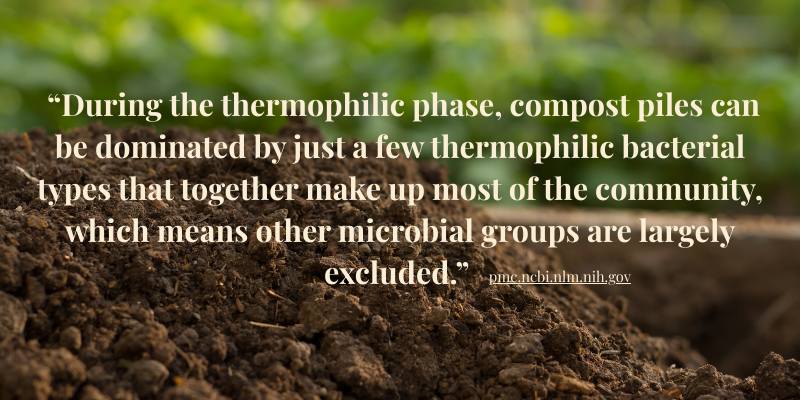
The Diversity Problem: Trading Resilience for Short-Term Gains
True soil health isn't just about having lots of microbes—it's about having the right diversity of microbes performing different functions. This is what I call functional redundancy, and it's your insurance policy against stress and disease.
Heavy applications of municipal compost often trigger a shift toward microbial homogenization:
Proteobacteria populations skyrocket: These are opportunistic microbes that excel at cycling carbon, nitrogen, and sulfur in nutrient-rich conditions.
Acidobacteria populations crash: These are versatile specialists adapted to stable, low-nutrient environments. They're often the first to disappear when soil is over-amended.
When you lose diversity in favor of a community dominated by a few compost-loving groups, you're not building soil strength—you're making it more uniform and less resilient to environmental stress. Dominance doesn't equal stability.
What This Means for Your Soil Management Strategy
I'm not telling you to stop using compost. Compost is, and will remain, essential for building healthy soil. But we need to be much more selective about the sources we use and how we apply them.
Here's what I recommend to my clients:
Know your source: Prioritize high-quality green waste compost or compost you make yourself from known materials over municipal solid waste compost or composted sewage sludge.
Test your compost: At minimum, know the EC, pH, and heavy metal content before you spread it on your land.
Get a microscope analysis: Having your compost assessed under the microscope to evaluate the actual biology present is highly recommended. This analysis will show you whether your compost contains the diversity of bacteria, fungi, protozoa, and nematodes that make up a biologically complete system. Chemical tests alone won't tell you if the living workforce in your compost is robust enough to support plant health.
Build biology first: Focus on creating a diverse, resilient soil food web that can actually defend against pathogens and process nutrients efficiently. Don't rely on compost to do the heavy lifting.
Apply strategically: More isn't always better. Heavy applications can overwhelm your native soil biology and create the problems I've described.
Monitor what's happening: Regular soil food web assessments can show you whether your microbial diversity is increasing or decreasing with your management practices.
The bottom line? We need to look past the marketing and understand the microscopic reality of what we're adding to our soils. Municipal and sewage-based composts aren't just "organic matter"—they're complex chemical and microbial deliveries that require scrutiny.
If we ignore the localized migration of heavy metals, the nutrient-advantaged persistence of pathogens, and the loss of microbial diversity, we risk trading long-term soil health for short-term fertility gains.
True stewardship means looking past the "black gold" label and making sure we're actually building the biological foundation our soils need to thrive.
Ready to See What's Really in Your Soil?
If you're serious about understanding the biology in your soil and compost, I can help:
Microscope Assessments: Send me your soil or compost samples, and I'll provide a detailed analysis of the bacterial and fungal biomass, protozoa, and nematodes present—so you know exactly what you're working with.
Learn to Use the Microscope Yourself: Want to assess your own samples? My microscope class will teach you how to identify and quantify soil biology so you can make informed decisions on your land.
Making Biologically Complete Compost: Ready to create compost that actually builds soil health? My online class walks you through the process of making compost with the diverse biology your soil needs.
Stop guessing. Start seeing what's really happening beneath the surface.