MicrobeGrower
Beyond the Soil Test: Understanding the Living System Beneath Your Feet
Science-backed insights on soil biology, regenerative agriculture, and building living soil systems that reduce inputs while increasing yields.

More Than Mud: The Secret Life of Your Soil and How to Feed It
The soil ecosystem operates through specialized microbial guilds, each performing distinct ecological functions:

Unlocking Clay Soils: The Science of Flocculation and Calcium Management
When clay platelets lie flat against one another in tightly packed arrangements—a condition called dispersion—the microscopic pore spaces essential for air and water movement effectively disappear. Oxygen cannot penetrate to support root respiration or aerobic microbial activity.
Powdery Mildew Defense: Building a Living Fungal Shield Through Foliar Biology
Conventional fungicide programs require continuous investment with no reduction over time as resistance develops. Biological approaches involve lower long-term direct costs. Once beneficial populations establish, application frequency typically decreases while effectiveness increases, creating improving economics over successive seasons.

Natural Aphid Control: Building Your Garden's Defense Team
The sustainable solution lies not in sprays and chemicals, but in cultivating the natural predators that have controlled aphid populations for millions of years. By understanding and supporting these beneficial organisms, you can establish a self-regulating system that maintains aphids at manageable levels without constant intervention.

- Dec 30, 2025
The Economic Case for Regenerative Agriculture: Building Prosperity Through Soil Health

The modern agricultural paradigm faces an increasingly apparent contradiction: despite decades of technological advancement and input intensification, many farming operations struggle with rising costs, declining margins, and degrading natural resources. Fertilizer expenses continue to escalate. Water availability becomes increasingly uncertain. Soil quality deteriorates despite—or perhaps because of—aggressive management practices. This trajectory is neither economically sustainable nor ecologically sound.
Yet a growing cohort of producers worldwide demonstrates a compelling alternative. By shifting management focus toward soil biological health, strategic water stewardship, and ecosystem function, these operations achieve what conventional wisdom suggests is impossible: simultaneously reducing input costs while improving yields, product quality, and long-term land value. This approach, broadly termed regenerative agriculture, represents not merely an environmental philosophy but a pragmatic economic strategy grounded in ecological principles and financial reality.
The Hidden Costs of Conventional Input Dependency
Contemporary agriculture operates on a fundamental assumption: productivity requires continuous external inputs. Synthetic nitrogen, phosphorus, and potassium applications maintain yields. Pesticides control competing organisms. Tillage manages weeds and incorporates amendments. This input-intensive model generates predictable results in the short term but creates escalating long-term liabilities.
Consider the economic trajectory of nitrogen fertilizer. Global prices have experienced dramatic volatility over recent decades, with periodic spikes creating severe financial stress for dependent operations. Beyond direct purchase costs, synthetic nitrogen application generates cascading expenses: additional lime to counteract soil acidification, fungicides to manage diseases proliferating in high-nitrogen conditions, and increased irrigation to support luxury growth. The biological cost proves equally significant—synthetic nitrogen suppresses the soil's natural nitrogen-fixing bacteria and reduces mycorrhizal colonization, creating physiological dependency that perpetuates the input cycle.
Water represents another dimension of hidden costs. Conventional tillage and low-organic-matter soils exhibit poor water infiltration and retention characteristics. This inefficiency translates directly to increased irrigation requirements, pumping costs, and vulnerability during drought periods. As water access becomes increasingly regulated and expensive across agricultural regions, these inefficiencies impose growing competitive disadvantages.
The regenerative approach fundamentally recalculates this equation. Rather than accepting input dependency as inevitable, it asks: what free ecological services are we failing to utilize?
Soil Biology: The Original Agricultural Technology
Healthy soil functions as a sophisticated biological system that performs essential agricultural services without external inputs. The organisms comprising the soil food web—bacteria, fungi, protozoa, nematodes, arthropods, and earthworms—execute functions that conventional management attempts to replace through purchased products.

Nitrogen fixation by free-living and symbiotic bacteria can provide 50-200 pounds of plant-available nitrogen per acre annually—without purchase, transportation, or application costs. Mycorrhizal fungi extend effective root systems by factors of 100 to 1000, dramatically improving water and phosphorus acquisition while reducing irrigation requirements. Predatory nematodes and arthropods suppress pest populations, decreasing or eliminating pesticide needs. Fungal decomposers transform organic residues into stable humus that improves water retention, reduces erosion, and builds long-term fertility.
These services represent substantial economic value. Research from the Rodale Institute's long-term farming systems trial demonstrates that after a transition period, organic systems utilizing cover crops and compost achieved equivalent yields to conventional systems while reducing input costs by 25-40%. More significantly, these biologically-managed systems showed superior drought resilience and premium market access—competitive advantages that prove decisive during periods of environmental or economic stress.
The key insight is straightforward: biological systems evolved over millions of years to cycle nutrients, manage water, and regulate populations efficiently. Learning to partner with these systems rather than override them reduces costs while improving function.
Water Management Through Living Systems
Water scarcity and quality represent accelerating constraints on agricultural viability. Traditional responses—deeper wells, expanded irrigation infrastructure, water rights acquisition—impose significant capital requirements while addressing symptoms rather than underlying inefficiencies.
Biological approaches target water management at the soil level. Aggregated soil structure, created and maintained by fungal hyphae and bacterial exopolysaccharides, dramatically improves infiltration rates. Research consistently demonstrates that biologically active soils can absorb rainfall 4-6 times faster than compacted, low-organic-matter soils, converting potential runoff into stored soil moisture. This single characteristic reduces irrigation requirements, minimizes erosion, and improves drought resilience.
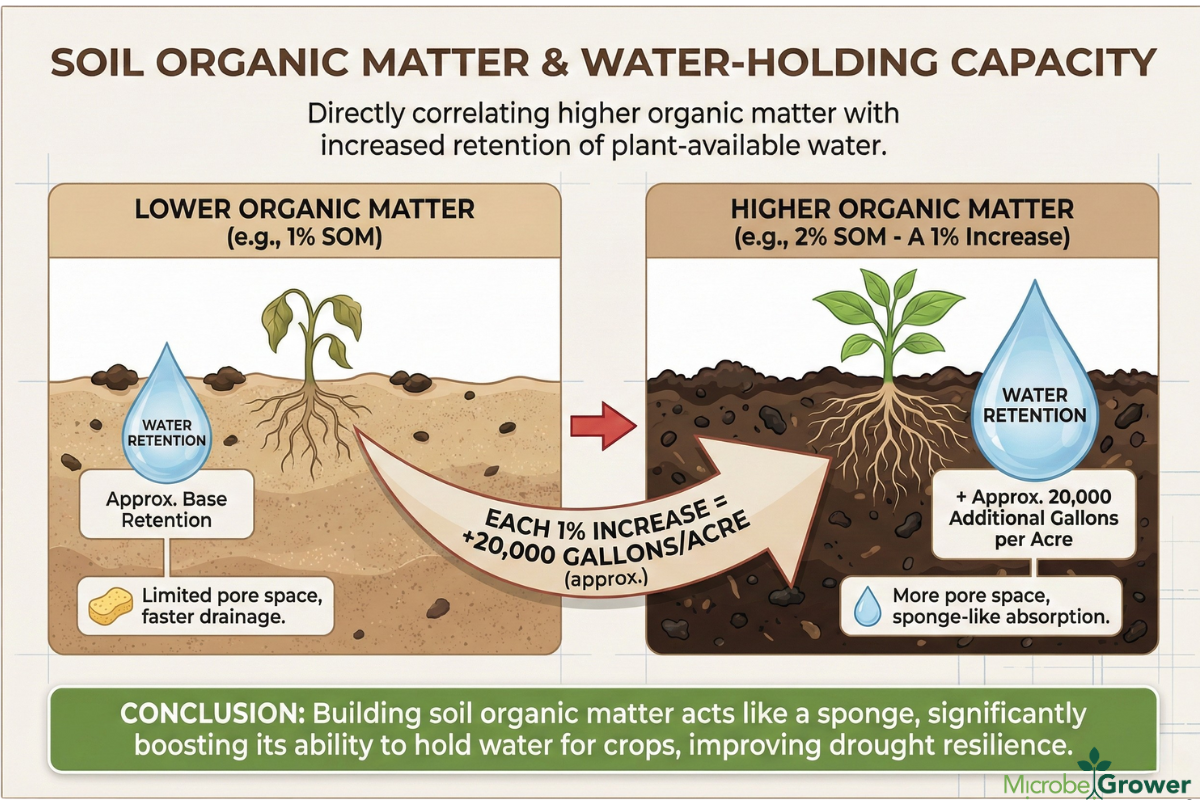
Organic matter content directly correlates with water-holding capacity. Each 1% increase in soil organic matter enables soil to retain approximately 20,000 additional gallons of plant-available water per acre. For producers facing water limitations or high pumping costs, building soil organic matter through cover cropping, compost application, and reduced tillage represents capital investment in water storage infrastructure—storage that simultaneously improves fertility, structure, and biological activity.
Living cover crops provide additional water management benefits beyond their contribution to soil organic matter. Deep-rooted species create macropores that improve infiltration and subsoil moisture recharge. Winter covers reduce evaporative losses during fallow periods. Proper cover crop termination timing and methods can position stored soil moisture optimally for subsequent cash crops.
These practices require management knowledge and operational adjustment rather than capital expenditure. The return on investment materializes through reduced irrigation costs, improved yield stability, and decreased vulnerability to climatic variation—economic resilience that proves increasingly valuable in an era of weather volatility.
The Economics of Transition and Optimization
Adopting regenerative practices involves both opportunity and challenge. The transition period—typically 2-5 years depending on initial soil condition and management history—requires learning new observational skills, adjusting equipment and timing, and potentially accepting temporary yield variations as soil biology reestablishes. These adjustments demand intellectual investment and operational flexibility.
However, the economic trajectory favors biological management. Input costs decline progressively as soil function improves. Fertility applications decrease as nutrient cycling accelerates. Pest pressure often diminishes as plant health improves and beneficial organism populations establish. Water efficiency increases continuously with organic matter accumulation and soil structure development.
Several operational strategies facilitate successful transition. Beginning regenerative practices on limited acreage allows learning without enterprise-wide risk. Selecting fields with existing challenges—compaction, erosion, persistent pest pressure—provides clear demonstration of improvement. Establishing baseline measurements of soil biological activity, organic matter, and water infiltration enables quantitative assessment of progress and return on investment.
Producer networks and experienced consultants provide critical support during transition. Learning from others who have successfully navigated similar changes accelerates skill development and reduces costly errors. Professional soil assessment—including biological analysis through microscopy and complementary chemical and physical testing—provides objective data for decision-making and progress tracking.
Beyond Cost Reduction: Value Creation

While input cost reduction represents the most immediate economic benefit of regenerative management, longer-term value creation proves equally significant. Improved soil health directly enhances product quality characteristics that command market premiums: nutrient density, flavor complexity, shelf life, and aesthetic quality. Crops grown in biologically active soils consistently demonstrate superior Brix levels, mineral content, and secondary metabolite production—characteristics that translate to market differentiation.
Land value appreciation represents another economic dimension. As agriculture confronts escalating environmental regulation, carbon markets, and ecosystem service compensation, properties demonstrating measurable soil health improvement will command premium valuations. Documented increases in organic matter, biological activity, and water infiltration represent quantifiable assets with recognized economic and ecological value.
Operational resilience—the capacity to maintain profitability despite weather variability, market fluctuations, and input price volatility—may constitute the most valuable outcome of regenerative management. Systems dependent on external inputs remain vulnerable to supply disruptions and price spikes beyond managerial control. Biologically-based systems, once established, generate increasing autonomy from external dependencies. This resilience translates to reduced financial risk, improved lender confidence, and enhanced long-term enterprise viability.
Implementing Change: From Concept to Practice

The transition from conventional to regenerative management requires more than philosophical commitment—it demands practical knowledge, observational skills, and adaptive management capabilities. Success depends on understanding your specific soil conditions, climatic context, and operational constraints while applying regenerative principles appropriately.
Soil biological assessment provides the essential starting point. Understanding current microbial populations, functional group balance, and biological activity levels establishes baseline conditions and identifies specific deficiencies requiring attention. This diagnostic approach enables targeted intervention rather than generic recommendations.
Developing observational skills transforms management decision-making. Learning to recognize indicators of soil biological health—aggregate stability, earthworm populations, residue decomposition rates, water infiltration patterns—enables real-time assessment and responsive management. These skills, once developed, provide permanent operational advantages that transcend any specific practice or protocol.
Strategic planning integrates regenerative practices into operational reality. Cover crop species selection must consider equipment availability, termination timing relative to cash crop planting, and specific soil-building objectives. Compost application rates and timing require coordination with nutrient management plans and labor availability. Reducing tillage intensity demands adjustments to planting equipment, residue management, and weed control strategies. Professional guidance accelerates this integration process while avoiding costly missteps.
The Path Forward: Investment in Knowledge
The regenerative agriculture movement represents not a rejection of agricultural science but its deeper application—utilizing ecological principles and biological processes to achieve economic and environmental outcomes simultaneously. This approach requires intellectual investment: learning to observe biological processes, interpret soil health indicators, and manage living systems rather than merely applying inputs according to predetermined schedules.
For producers evaluating this transition, the fundamental question is not whether regenerative practices work—extensive research and practitioner experience confirm their efficacy—but rather how to implement them successfully within specific operational contexts. This question demands individualized assessment, strategic planning, and skilled guidance.
Ready to Transform Your Operation? Let's Start the Conversation.
1. Comprehensive Soil Health Assessment & Strategy Session
Schedule a complete evaluation of your operation's current soil biological status, water management efficiency, and input cost structure. Through detailed soil microscopy, infiltration testing, and operational analysis, we'll identify specific opportunities for cost reduction and productivity enhancement tailored to your operation. This 3-hour consultation includes written recommendations with implementation priorities and projected return on investment. [Book Your Assessment Now]
2. Customized Regenerative Transition Planning
Work one-on-one to develop a multi-year transition strategy specifically designed for your land, crops, equipment, and financial objectives. This comprehensive consultation service includes baseline soil testing, personalized cover crop recommendations, compost and biological amendment protocols, and ongoing monitoring support through your first growing season. Transform your approach while minimizing risk and maximizing economic returns. [Schedule Your Planning Session]
3. Ongoing Management Support & Optimization Coaching
Join a select group of producers receiving monthly soil health monitoring, seasonal management consultations, and priority access for troubleshooting challenges as they emerge. This premium service ensures you're never managing complex biological systems alone—you'll have expert guidance for decision-making, problem-solving, and continuous optimization as your soil health journey progresses. Limited availability. [Apply for Coaching Program]
Don't let another growing season pass while profits leak away through unnecessary inputs and declining soil function. The investment you make in understanding and improving your soil health will return dividends for decades to come.