MicrobeGrower
Beyond the Soil Test: Understanding the Living System Beneath Your Feet
Science-backed insights on soil biology, regenerative agriculture, and building living soil systems that reduce inputs while increasing yields.

More Than Mud: The Secret Life of Your Soil and How to Feed It
The soil ecosystem operates through specialized microbial guilds, each performing distinct ecological functions:

Unlocking Clay Soils: The Science of Flocculation and Calcium Management
When clay platelets lie flat against one another in tightly packed arrangements—a condition called dispersion—the microscopic pore spaces essential for air and water movement effectively disappear. Oxygen cannot penetrate to support root respiration or aerobic microbial activity.
Powdery Mildew Defense: Building a Living Fungal Shield Through Foliar Biology
Conventional fungicide programs require continuous investment with no reduction over time as resistance develops. Biological approaches involve lower long-term direct costs. Once beneficial populations establish, application frequency typically decreases while effectiveness increases, creating improving economics over successive seasons.

Natural Aphid Control: Building Your Garden's Defense Team
The sustainable solution lies not in sprays and chemicals, but in cultivating the natural predators that have controlled aphid populations for millions of years. By understanding and supporting these beneficial organisms, you can establish a self-regulating system that maintains aphids at manageable levels without constant intervention.
- Dec 28, 2025
Deep Dive into Nutrient Recycling
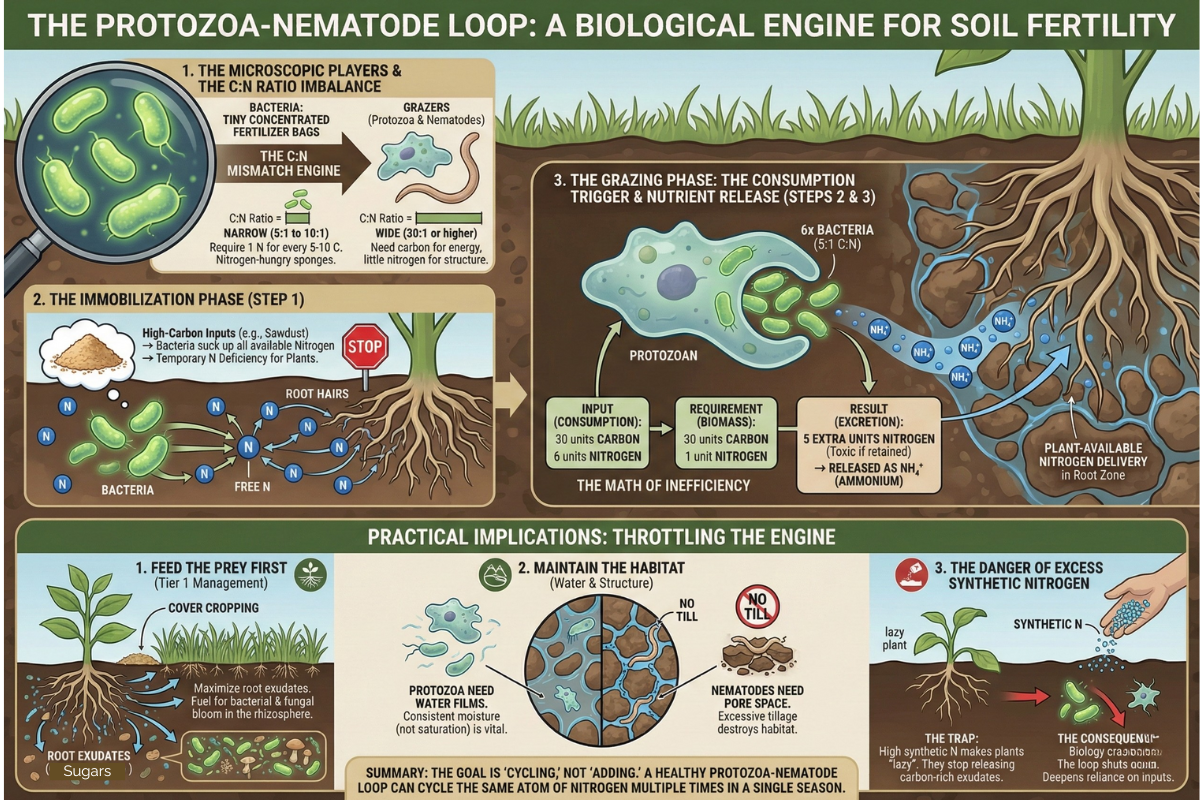
Think of bacteria as tiny bags of concentrated fertilizer. They have a very narrow C:N ratio, often around 5:1 to 10:1. This means for every 5 to 10 atoms of carbon they use to build their bodies, they require 1 atom of nitrogen. They are nitrogen-hungry sponges.
The Immobilization Phase (Step 1) is actually a competitive phase. Bacteria are far more efficient at grabbing free nitrogen from the soil solution than plant roots are. If you apply compost or an organic amendment with too much carbon (like sawdust), the bacteria will suck up every bit of available soil nitrogen to digest that carbon, causing a temporary nitrogen deficiency for your plants.
The Grazing Phase (Steps 2 & 3) works because of a massive inefficiency:
Protozoa (amoebae, flagellates, ciliates) and beneficial nematodes have much wider C:N ratios—often around 30:1 or higher. They need a lot of carbon for energy, but relatively little nitrogen to build their structures.
To get the 30 units of carbon they need for survival, a protozoan might have to consume six bacteria (assuming bacteria are 5:1).
The Math: In consuming those six bacteria, the protozoan ingests 30 units of Carbon and 6 units of Nitrogen.
The Requirement: The protozoan only needs 1 unit of Nitrogen to match the 30 units of Carbon it just utilized.
The Result: It has 5 extra units of Nitrogen that are biologically toxic if retained. It must excrete them immediately.
This excretion is released into the soil water film as NH₄⁺ (ammonium)—the exact form of nitrogen plants prefer to uptake, delivered right in the root zone where these interactions are happening.
Practical Implications for the Advanced Grower
Understanding the theory is one thing; managing it for yield is another. If the Protozoa-Nematode Loop is your engine, you need to know how to throttle it up and maintain it.
1. Feed the Prey First (Tier 1 Management)
You cannot have a thriving predator population without a massive prey population.
Action: Maximize root exudates through continuous living roots (cover cropping). Root exudates are cakes and cookies for bacteria and fungi, causing their populations to explode in the rhizosphere (root zone). The bigger the bacterial bloom near the root, the more intense the grazing will be right where the plant needs the nutrient release.
2. Maintain the Habitat (Water and Structure)
Tier 2 organisms have specific physical requirements.
Protozoa need water films: They are aquatic organisms that swim in the thin films of water surrounding soil particles. If the soil dries out completely, they go dormant (cysts) and mineralization stops. Consistent moisture (not saturation) is vital.
Nematodes need pore space: Beneficial nematodes are microscopic worms that need soil pores to move through. Excessive tillage crushes soil aggregates, collapses pore spaces, and physically kills larger nematodes, halting this part of the cycle.
3. The Danger of Excess Synthetic Nitrogen
For the grower transitioning from conventional to regenerative practices, this is the hardest hurdle.
The Trap: If you apply high amounts of synthetic nitrate/ammonium fertilizers, plants become "lazy." They stop pumping out carbon-rich root exudates because they don't need to trade for nitrogen.
The Consequence: Without root exudates, the bacterial populations near the root zone crash. Without bacteria, the protozoa starve. The entire loop shuts down, deepening reliance on the synthetic inputs.
Summary: The Goal is "Cycling," Not "Adding"
The advanced grower realizes that fertility isn't about how much nitrogen you add to the soil; it's about how fast the biology can cycle the nitrogen already there. A healthy Protozoa-Nematode loop can cycle the same atom of nitrogen through several organisms and into the plant multiple times in a single growing season.